
Showing posts with label Yoko Ogawa. Show all posts

Tuesday, July 26, 2016

Somewhere deep inside I was praying that voice would someday give me an order, too

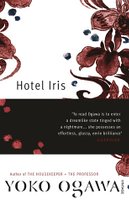
Every time I read Ogawa, I think of The Housekeeper and the Professor which was such a quiet and sweet story. But then I read something like Hotel Iris which has the same feel and tone but maaaaaaaan the topic is not the same. It is crazy impressive that she can write something that is clearly her and yet so different.

So, what is Hotel Iris about? Teenage Mari works at the family hotel, this falling-apart place in a seaside town. Mari doesn't go to school, since her mother makes her work. She doesn't have any friends. That would take her away from work.

One day there's an altercation with a couple of the guests. A prostitute is yelling at the man in the hotel room, waking up the other guests. When Mari's mother goes to deal with it (meaning, kick people out and figure out who is going to pay for the room) the man yells something and Mari is drawn to his voice.

Turns out he's this older man, an otherwise quiet and unassuming translator who lives on a nearby island. There are some rumors that he killed his wife. But none of that matters. All that matters to Mari is that voice. And probably getting out from under her mother's thumb. Of course, what is she getting into.

So Mari reaches out to the man. And thus their meetings begin and to say anymore is to get into spoiler territory so I'll just say there's "an illicit affair" and "a dark realm of both pain and pleasure" (both quotes from the back of the book). So yeah, things get a little 50 Shades-ish. Let's say it goes in a VERY different direction than Housekeeper and Professor. I could see it fitting in Revenge.

The story is quiet but in an off-tempo way. Like something is askew but you haven't quite figured out what. Not even when things get weird. I mean, you know the direction the story is going, but that same background feeling still lingers. The story draws you in, even when you'd rather look away.

Gif rating:
But also some of this
Ogawa, Yoko. Hotel Iris. Random House, 1996.

Tuesday, February 16, 2016

The desires of the human heart know no reason or rules

Since I'm so behind on writing reviews, I had gotten pretty good at least writing myself some notes after I finished a book. That way, when I actually got around to writing the review itself I wasn't starting from scratch on a book I hadn't touched in a couple months. Apparently I skipped right over Yoko Ogawa's Revenge with the whole note writing thing, which I finished back in November. Luckily I liked this book so it made an impression on me.

Revenge, described as eleven dark tales, are eleven interconnected short stories. The interconnections aren't all that obvious at first and it was about halfway through that I started noticing little details turning up in multiple stories. I thought about starting over again with this in mind, but I didn't because half way through already. And the stories can stand on their own, so not noticing the connection earlier didn't really change the stories.

The stories are dark, though that doesn't necessarily mean they're scary. Sometimes they're just sad or there's a general sense of unease, though you can't quite place your finger on what is wrong. And most of the stories don't really deal with revenge, so Eleven Dark Tales is probably a better title. But Revenge is zippier so fine.

The book opens with a woman waiting in a bakery to buy a strawberry shortcake. A simple, even boring, premise. The story stays quiet but slowly a sense of sadness and eeriness starts to permeate as you learn the story of this woman sitting in the empty bakery. And thus the tone is set for the rest of the stories. They all have the same sense of quiet that builds to something not quite right, certainly not what you would have expected, but that works with the story, even if it involves breaking into a former post office to grab a kiwi from one of the many boxes piled up to the ceiling. Or the woman who grows carrots in the shape of hands. Or the man who runs the museum of torture.

I really enjoyed this collection. I love the tone it has; it's creepy and weird but quiet. It's not scary so if you're worried about horror stories, I'd say this is a good one to check out. Plus Ogawa's writing is great (and I guess part of that credit goes to translator Stephen Snyder) so really, can't go wrong.

GIF rating:
Title quote from page 90, location 1054

Ogawa, Yoko. Revenge: Eleven Dark Tales. Picador, 2013.

Thursday, March 6, 2014

The truly correct proof is one that strikes a harmonious balance between strength and flexibility

During a recent(ish) trip to Boston my friend lent me a copy of The Housekeep and the Professor by Yoko Ogawa, which is awesome because I love hanging out with friends AND getting new books to read. Particularly ones that have been on my radar, but sort of the outskirts. I knew of it, but it wasn't something I was searching out.

This is the story of, surprise, a professor and a housekeeper. And the housekeeper's son. There are a few other characters but they are not the focus. It's just these three.

The Professor was a math professor. He hasn't been a professor in a long time, not since he was in a car accident that robbed him of his memory. Now his memory only lasts 80 minutes. He mostly gets by using notes attached all over his suit with little reminders about his day, who people are, and of course of his condition.

His memory problem necessitates the Housekeeper. She does more than just clean the house. She's there all day long, cleaning, cooking, and running errands for the Professor. She's hired by the Professor's sister-in-law. He lives in a cottage behind her main house, and tells the Housekeeper that she does not  want to be disturbed by any problems. If there is an issue with the Professor she would like the Housekeeper to work it out on her own.

When the Professor learns the Housekeeper has a young son that spends his afternoons at home alone while she's working, he insists the boy come to his house until it's time for the Housekeeper to go home, because a child should be with his mother. And so the Housekeeper's son Root becomes a fixture at the house and a favorite of the Professor.

There isn't too much of a plot here, but that doesn't mean this was a slow book. I finished it in a day (half on my morning commute, half in the evening). I loved watching the characters interact. And while math is far from a favorite subject of mine, the Professor's enthusiasm and joy for numbers almost makes me want to learn more math. I liked the conversation between the Professor and the Housekeeper.

"The person who discovered amicable numbers must have been a genius."
"You might say that: it was Pythagoras, in the sixth century B.C."
"Did they have numbers that long ago?"
"Of course! Did you think they were invented in the nineteenth century? There were numbers before human beings - before the world itself was formed."

The Professor is constantly working on complicated mathematical proofs and problems from various math journals and sending them away for prizes, although he really doesn't care about the prizes. He's happy to be solving the problems and he teaches the Housekeeper and Root the joy in finding these numerical connections and solving these mysteries.

It's a beautifully written story and I suppose some of that credit goes to Stephen Snyder for his translation from the original Japanese.

If you're looking fora  quiet and quick read, I would recommend this one. And I promise, a love of math is not necessary to enjoy.

Title quote from page 16

Ogawa, Yoko. The Housekeeper and the Professor. Picador, 2003. Translated by Stephen Snyder.